Introduction
Carcassonne rises from the Languedoc plain like a storybook illustration brought to life — a place where the Middle Ages still live in every stone.
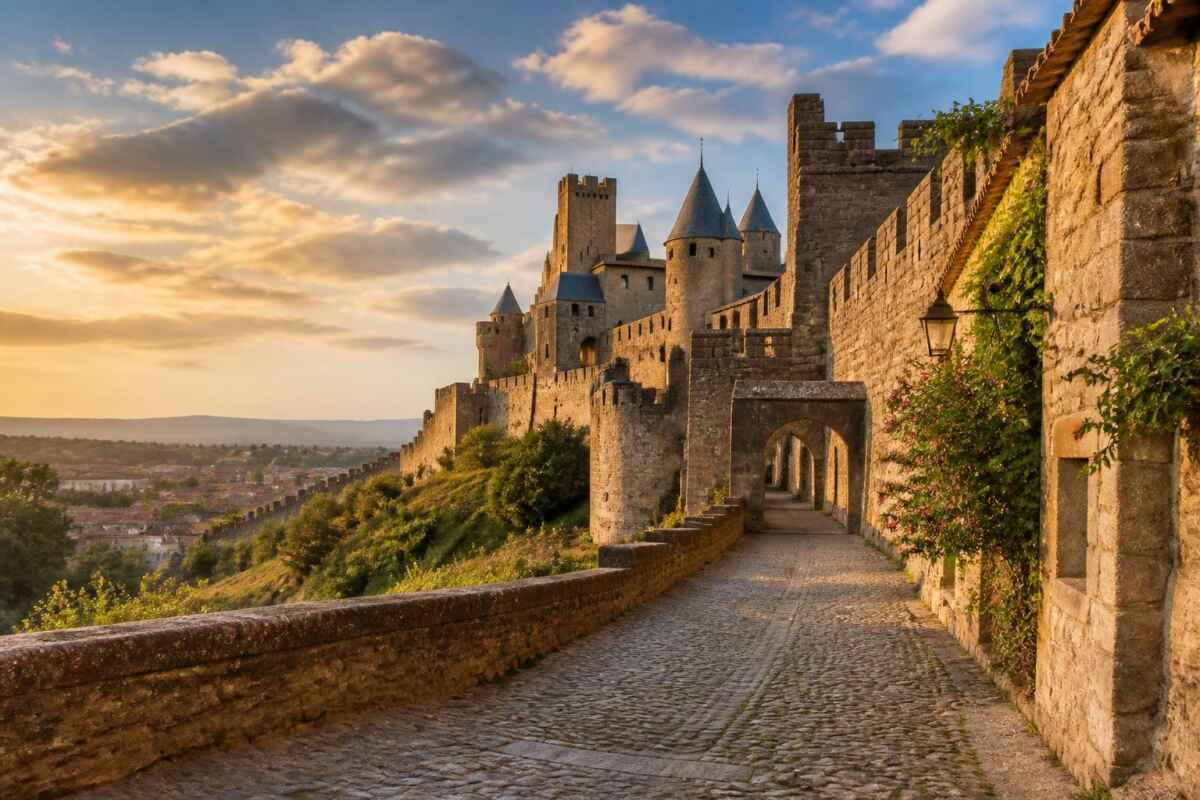
As you approach, the double ring of fortified walls and fifty-two towers seem to float on the horizon, precisely the image that has captured the imagination of travelers, historians, and artists for centuries.
This is not a themed attraction or a restored fragment; it is a living citadel that has watched over trade routes, wars, and royal power since Gallo‑Roman times.
The moment you step through the Porte Narbonnaise, the bustle of modern life fades into a labyrinth of cobbled lanes, half‑timbered houses, and the scent of woodsmoke and cassoulet.
Whether you come for the UNESCO World Heritage status, the Cathar legends, or simply to stand on the ramparts at sunset, Carcassonne does something rare: it makes you believe, just for a while, that you have walked into another century.
What Makes Carcassonne a UNESCO World Heritage Treasure?
Carcassonne earned its UNESCO World Heritage inscription in 1997 primarily for its outstanding medieval fortress town, but the recognition also celebrates the meticulous 19th‑century restoration led by Eugène Viollet‑le‑Duc.
The site represents a unique fusion of Roman, Visigothic, and feudal military architecture, layered over more than 2,500 years of settlement.
Walking the ramparts, you can trace the evolution of defensive design — from Gallo‑Roman stone blocks to the conical slate roofs and pointed merlons added by Viollet‑le‑Duc, which still spark debate among purists.
The designation covers not only the walled Cité but also the Canal du Midi skirting the lower town, linking Carcassonne to a broader narrative of European trade and engineering.
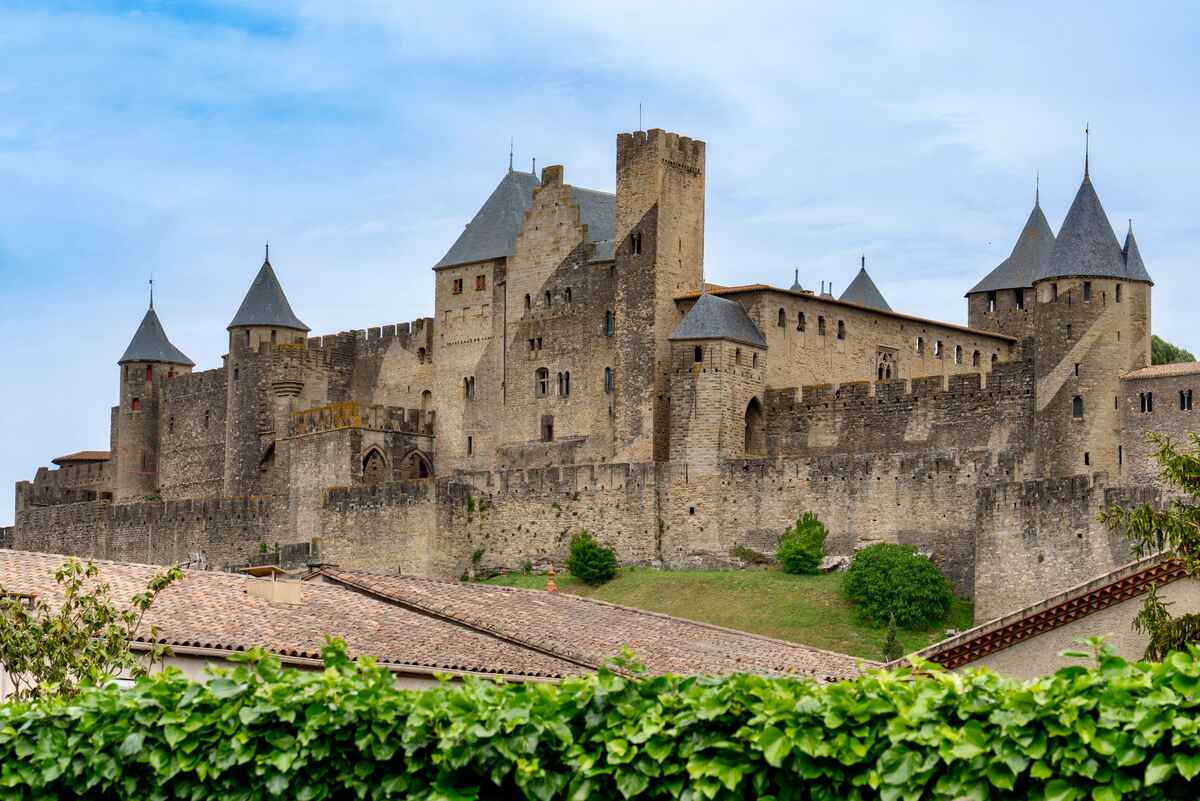
What sets Carcassonne apart from many other fortified towns is the sheer completeness of its enceinte. Two concentric curtain walls with a tournament ground between them create a sophisticated defensive system that was virtually impregnable in its prime.
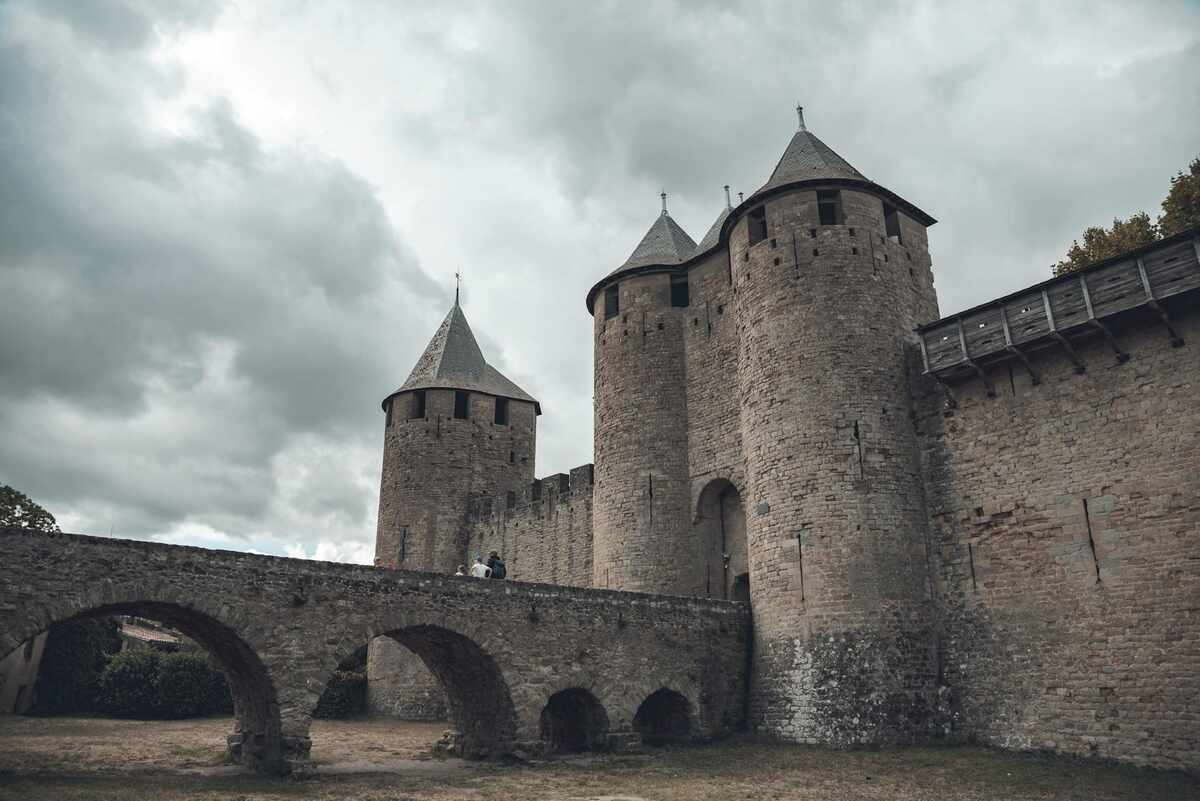
The inner wall, with its ancient Roman core, rises dramatically above the outer, while the barbican and drawbridge at the main gate still convey the same strategic gravity they held during the Albigensian Crusade.
For historians, the site is a textbook of medieval siege warfare; for visitors, it is a journey into a perfectly preserved world once dominated by the Trencavel viscounts.
The UNESCO listing also acknowledges the broader cultural landscape. Carcassonne sits at a strategic crossroads between the Atlantic and Mediterranean, and between the Massif Central and the Pyrenees, which shaped its prosperity and its conflicts.
The lower town, or Bastide Saint‑Louis, itself a 13th‑century planned city, complements the fortress with a chequerboard street pattern and a quieter, everyday French rhythm. Together, these elements create a living urban ensemble where pastry shops, bookbinders, and weekly markets coexist with battlements.
In practical terms, UNESCO status means strict preservation rules that protect the silhouette of the Cité from intrusive development, so the views remain remarkably free of modern clutter.
It also means that conservation decisions are made with international oversight, balancing visitor access with the integrity of the monuments. For today’s traveller, the result is a heritage site that feels authentic rather than staged — a place where the physical fabric of the Middle Ages remains the main character.
The History of Carcassonne: From Roman Fortress to Fairytale Citadel
Carcassonne’s history begins long before its medieval heyday. The hilltop was fortified as early as the 6th century BC by the Volcae Tectosages, but it was the Romans who recognised its strategic value, building an oppidum and later a fortified town known as Carcaso.
Sections of the inner rampart still contain distinct Roman masonry, particularly around the northern gate. By the 5th century, the Visigoths held the city, strengthening its walls and establishing it as a key defensive position against Frankish expansion. This layering of civilisations created the extraordinary palimpsest you see today.
The medieval period, however, brought the drama that still defines Carcassonne’s identity. In the 12th and 13th centuries, the city was the seat of the powerful Trencavel family, who found themselves at the centre of the Albigensian Crusade against the Cathars.
In 1209, the crusader army laid siege to Carcassonne, and after a short but brutal campaign, Viscount Raymond‑Roger Trencavel was captured and the city fell. Carcassonne then passed to the French crown, which transformed it into a formidable royal fortress along the sensitive border with Aragon.
Louis IX and Philip the Bold invested heavily in a second outer wall, creating the concentric defence system that remains a masterpiece of military engineering.
The new fortifications were designed to make any assault staggeringly costly, with overlapping fields of fire, steep scarps, and gateways that forced attackers into exposed kill zones.
For several centuries, Carcassonne was considered one of the most secure strongholds in Europe, and its military importance persisted until the Treaty of the Pyrenees in 1659 shifted the frontier farther south.
By the 19th century, the fortress had fallen into an advanced state of decay, and demolition of its outer walls was actually under consideration when a local campaign led by Jean‑Pierre Cros‑Mayrevieille and Prosper Mérimée intervened.
Eugène Viollet‑le‑Duc’s comprehensive restoration, from 1853 onward, saved the monument but also introduced controversial elements like the pointed slate roofs and the statue of Lady Carcas.
Modern scholarship acknowledges both his genius and the 19th‑century romanticism woven into the stones. Today, the result is a dialogue between original medieval substance and visionary reconstruction — a fairytale citadel that history itself could not have scripted better.
How to Get to Carcassonne: Trains, Planes, and Road Trips
Reaching Carcassonne is surprisingly straightforward, even though the fortress looks like it belongs in a remote mountain pass. The city sits in the Aude department in Occitanie, well connected by rail, air, and motorway.
Carcassonne Airport (CCF), located just a few kilometres west of the Cité, offers seasonal low‑cost flights from several European hubs, including London, Brussels, and Dublin.
For travellers from outside Europe, the most practical strategy is to fly into Toulouse‑Blagnac (TLS) and then take a direct train or rent a car for the scenic one‑hour drive east along the A61 autoroute.
The railway connection is arguably the most romantic way to arrive. Carcassonne station is on the Bordeaux‑to‑Marseille main line, with frequent TGV and Intercités services.
From Paris, the high‑speed TGV can whisk you to nearby Narbonne in under four and a half hours, after which a local TER train completes the last leg in about 30 minutes.
From Barcelona, the journey is equally rewarding; you cross the border and glide through Perpignan and Narbonne before catching the first glimpse of the turreted skyline from the train window — a moment that still thrills first‑time visitors.
If you choose to drive, the A61 (Autoroute des Deux Mers) links Carcassonne directly to Toulouse and Montpellier, and the city is a popular stop on a longer road trip through southwestern France.
The approach from the east is particularly dramatic: as you crest a gentle rise near Trèbes, the Cité abruptly fills the windscreen, floating above the vineyards like a mirage.
Be aware, however, that parking in the immediate vicinity of the Cité is limited and can be expensive in high season; many savvy travellers leave their car in the Bastide Saint‑Louis and walk or take the free city shuttle across the Pont Vieux.
For cyclists, the Canal du Midi towpath offers a peaceful, car‑free route that threads directly through Carcassonne. This UNESCO‑listed waterway can be followed from Toulouse or as far as Sète, and the local tourist office provides excellent maps for a day ride.
While Carcassonne is not a large city, arriving by train or bicycle reinforces the historical atmosphere, slowing your pace to match that of the old stones. Whichever mode of transport you choose, checking current schedules and flight availability is essential, as services can reduce significantly outside the peak summer months.
Best Time to Visit Carcassonne: Seasons, Crowds, and Festivals
The ideal time for a visit depends heavily on what you want from your Carcassonne experience, though the destination is genuinely year‑round.
Weather, crowd density, and the cultural calendar shift dramatically from one season to the next. In summer, the fortress basks in long, sunny days perfect for rampart walks, but that also means thick tourist crowds, especially from late June through August.
If you do come in high season, early morning or late afternoon entry helps you experience the lanes in a quieter light.
| Season | Months | Weather & Temperature | Crowds | Notable Events |
|---|---|---|---|---|
| Spring | March – May | Mild, 12–20°C, occasional rain | Moderate | Easter processions, local flower markets |
| Summer | June – August | Hot, 25–35°C, mostly dry | Very high | Festival de Carcassonne (music, theatre), Bastille Day fireworks over the Cité |
| Autumn | September – November | Pleasant, 14–24°C, some rain later | Low to moderate | Grape harvest, Magique Medieval Christmas market prep |
| Winter | December – February | Cool, 3–11°C, occasional mistral wind | Low | Christmas market inside the Cité, New Year’s Eve spectacle |
Spring is a magnificent compromise. In April and May, the plane trees along the Canal du Midi turn vivid green, and the wildflowers around the lower ramparts are at their peak.
Daytime temperatures hover between 15°C and 20°C — comfortable for climbing the towers without overheating. Fewer tour buses mean you can enjoy the inner courtyards and smaller museums without feeling rushed.
Hotel prices, while not rock‑bottom, are generally lower than in summer, and restaurant terraces in the Bastide begin to fill with a pleasant local hum rather than an international crush.
Autumn offers its own magic, particularly from mid‑September through October. The fierce summer heat retreats, the vines turn copper and gold, and the slanting light makes the stone glow in shades of honey and ochre.
This is harvest season in the surrounding Minervois and Corbières vineyards, so you can pair a tour of the ramparts with genuine cellar‑door experiences just a short drive away.
By November, the first chill arrives, and the Cité wraps itself in a quieter, more introspective atmosphere, though many restaurants and some smaller hotels begin to close for their annual winter break.
Winter, while cold, can be unexpectedly rewarding. The Cité decked in twinkling Christmas lights during the Magique Medieval market feels intimate rather than bleak, and you are likely to share the fireside tables in local bistros with residents rather than tourists.
The biggest trade‑off is shorter opening hours and the risk of ice on the highest rampart sections, which occasionally forces temporary closures.
Whenever you go, always check the forecast for the famous tramontane wind, which can sweep across the plain with surprising force, and confirm the calendar for the Festival de Carcassonne if you hope to combine your visit with live performances inside the medieval theatre.
Exploring the Medieval Cité of Carcassonne: A Walk Through Time
A proper visit to Carcassonne starts by crossing the drawbridge at the Porte Narbonnaise, the main eastern gate flanked by two stout towers. From the moment you pass beneath the iron portcullis, the 21st century retreats and the city reveals itself as a dense medley of narrow lanes, tiny squares, and gothic traceries.
While a map is useful, aimless wandering is the real pleasure; you will stumble upon artisan workshops, hidden courtyards, and sudden glimpses of the Pyrenees through arrow slits. Allow at least half a day for the Cité alone, far more if you want to visit every nook and cranny.
The rampart walk is the definitive experience. Access runs along much of the inner and outer walls, with wooden footbridges crossing between towers and interpretive panels explaining the ingenious defensive features.
From the higher galleries, you overlook the tournament ground, or lices, where tournament recreations sometimes take place in summer.
The views outward sweep across the Aude river valley, the Bastide’s red‑tiled roofs, and the black‑draped hills of the Montagne Noire to the north. This high‑vantage perspective is what makes the ticket price feel entirely justified.
Inside the walls, you will find the Château Comtal, a 12th‑century castle within the fortress that served as the Trencavel residence. Its square‑keep silhouette and interior museum offer a focused lesson in Romanesque and Gothic architecture, including some remarkably preserved wall paintings.
The Basilica of Saints Nazarius and Celsus, located just a few steps away, is another essential stop; its Romanesque nave and sublime Gothic stained‑glass windows — some dating from the 13th century — create an atmosphere of deep stillness that contrasts with the bustling souvenir lanes.
As the day wears on, the Cité starts to empty of day‑trippers, and the character shifts subtly. The restaurants that run along the rue du Plo and the place Marcou become softer and more inviting.
At dusk, the floodlights bathe the ramparts in warm gold, and a circuit of the outer walls becomes a breathtaking promenade. Many visitors simply walk the full perimeter on the exterior path, especially along the western flank where the Aude river hugs the base of the fortifications.
This twilight hour — when the bats begin to swoop above the lices — is Carcassonne at its most poetic, and it costs nothing to enjoy.
How Many Days Do You Need in Carcassonne?
For a first visit that includes the Cité’s main monuments, a leisurely lunch, and a stroll through the Bastide Saint‑Louis, two full days is the sweet spot. With one night, you can experience the fortress after the tour buses leave and catch the ramparts in soft morning light before continuing your journey.
A two‑night stay gives you the chance to visit the Château Comtal, walk the walls, enjoy the southern French food scene, and still include a half‑day excursion to a nearby Cathar castle or a vineyard without feeling rushed. Many travellers treat Carcassonne as a quick whistle‑stop, but the destination rewards those who linger.
A single‑day itinerary can still be richly satisfying if you plan carefully. Arrive by 9:30 a.m., start with the rampart walk to beat the midday heat, then see the Basilica and the Château Comtal before sitting down for a cassoulet lunch around 1 p.m.
Reserve the late afternoon for a gentle descent to the Bastide to visit the market square and perhaps the Musée des Beaux‑Arts before taking a taxi or the shuttle back to the station.
The main sacrifice with a day trip is losing the sunset and nocturnal enchantment, which many consider the most memorable part of the Carcassonne experience.
If your broader itinerary allows, a three‑day Carcassonne-centred stay opens up the region beautifully. You could dedicate the third day entirely to the surrounding countryside: the Cathar castles of Lastours, the abbey of Fontfroide, or the vineyards of Minervois and Corbières.
This slower rhythm also lets you explore the Canal du Midi on foot or by bike, savour an evening meal in a small Bastide bistro, and maybe catch a concert if you are visiting during the July festival.
In three days, Carcassonne shifts from being a checkmark on a road‑trip map to a genuine destination with its own pace of life.
One practical note: accommodation choices affect how many days feel comfortable. Staying inside the Cité is atmospheric but can mean hauling luggage over cobblestones and up narrow staircases, so a two‑night minimum makes that effort worthwhile.
If you stay in the Bastide or a quieter guesthouse just outside the walls, a single night might suffice logistically, but you will still wish you had booked more. In every case, booking ahead is wise, especially from June through September, as demand frequently outstrips supply in this compact city.
Where to Stay in Carcassonne: Inside the Ramparts or the Bastide?
Choosing where to stay in Carcassonne shapes the entire tenor of your trip. The Cité intra‑muros feels undeniably magical after dark, when the day‑trippers have vanished and the cobbled streets glow under lantern light.
Hotels and guesthouses inside the walls tend to occupy historic buildings with exposed stone, winding staircases, and windows framing turrets.
The trade‑off is practical: vehicle access is tightly controlled, so you may need to park outside and walk with your bags, and rooms are generally smaller due to the constraints of medieval architecture.
The Bastide Saint‑Louis, the “new” town laid out in the 13th century, offers a very different but equally legitimate experience.
Here, life follows a contemporary French rhythm: locals shopping at the Saturday market, schoolchildren cycling through the plane‑shaded squares, and plenty of cafés where the main sound is espresso machines rather than multilingual chatter.
Accommodation ranges from modest family‑run hotels to chic boutique guesthouses, and you are far more likely to find amenities like lifts, air conditioning, and on‑site parking. The Bastide also puts you closer to the train station and the Canal du Midi.
A third option, increasingly popular, is the intermediate zone just below the Cité’s slopes, particularly around the Pont Vieux and the rue Barbacane.
A handful of charming bed‑and‑breakfasts here give you a view of the ramparts from your window and a short uphill walk to the fortress without the full‑time immersion in the tourist zone.
These locations often have gardens or small pools, a real asset during the hot Languedoc summer when the stone walls radiate heat. Prices in this zone can be lower than inside the Cité but higher than the Bastide centre, so it is worth comparing early.
Some essential booking tips apply across the board. July and August demand reservations months in advance, and even shoulder‑season weekends can sell out when festivals are on.
Always confirm whether breakfast is included and ask clearly about accessibility if you have mobility concerns — many historic properties have no lift, and the cobblestones inside the Cité are uneven.
Whether you choose the Cité for pure atmosphere, the Bastide for comfort and authenticity, or the hillside for a compromise, having a base in Carcassonne lets you experience the fortress at dawn and dusk, the two hours that repay the stay.
Top Things to Do in Carcassonne Beyond the Castle Walls
Once you have walked the ramparts, visited the Château Comtal, and admired the Basilica’s windows, a broader Carcassonne experience awaits beyond the fortress. The first gem many visitors overlook is the Bastide Saint‑Louis itself.
Its chequerboard grid of streets, anchored by the grand place Carnot, is one of the finest examples of medieval urban planning in France.
On Saturday mornings, the square transforms into a vibrant food market where you can taste olives, honey, and local goat cheeses while watching the city go about its affairs.
The Musée des Beaux‑Arts, housed in the former Présidial building near the eastern edge of the Bastide, holds a small but dignified collection of European paintings from the 17th to 19th centuries.
The quiet galleries offer a cooling contrast to the bustling Cité, and the building’s courtyard is a lovely spot to rest.
Another cultural stop, the Maison des Mémoires on rue de Verdun, is a beautifully restored hôtel particulier dedicated to local ethnography and the life of author Joë Bousquet, providing a deeply intimate look at Occitan traditions.
For a change of pace, the Canal du Midi offers a gently shaded promenade perfect for walking or cycling. You can rent a bicycle near the station and pedal eastward along the towpath, passing locks and plane trees that were planted in the 17th century.
The stretch between Carcassonne and the lock at Écluse d’Herminis is particularly pleasant, with several picnic spots overlooking the water. Boat trips from the port are also available in season, giving you an entirely new perspective on the city’s defensive geography.
- Pont Vieux: The 14th-century bridge offers the most photographed view of the Cité, especially at sunrise.
- Museum of the Inquisition: A small, privately run museum inside the Cité that sparks conversation about medieval justice.
- Lac de la Cavayère: A recreational lake just a few kilometres from town, ideal for swimming on hot days.
- Wine Cellar Visits: Numerous cooperatives and domains in the Carcassonne AOC area offer tastings of Aude Valley reds and rosés.
Carcassonne’s Culinary Scene: Cassoulet and Local Flavors
No discussion of Carcassonne is complete without cassoulet, the slow‑cooked bean and meat stew that is the soul of Languedoc cuisine.
In Carcassonne, the dish takes its own local form, typically including white lingot beans, duck confit, Toulouse sausage, and a crust of golden breadcrumbs that is repeatedly broken and allowed to reform.
Restaurants inside the Cité often serve it in ceramic cassoles, but be selective; some tourist‑oriented kitchens reheat mass‑produced versions.
For the genuine article, follow locals to the Bastide, where family‑run establishments like Brasserie A 4 Temps or Restaurant Gil prepare it with fiercely guarded house recipes.
Beyond cassoulet, Carcassonne sits at the centre of an underrated culinary triangle. Fresh produce from the Lauragais plain, seafood from the Mediterranean reaches just an hour away, and mountain cheeses from the Pyrenean foothills converge here.
Salade languedocienne with warm goat cheese and walnut‑oil vinaigrette appears on almost every bistro menu, while the local truffle season in winter elevates scrambled eggs and omelettes into something memorable.
The Sunday lunch ritual remains sacred, and many restaurants offer a prix‑fixe menu that represents excellent value.
Sweet treats deserve attention, too. The traditional biscuit called croquants de Carcassonne — twice‑baked almond biscuits often flavoured with orange blossom — make a perfect accompaniment to coffee.
Pastry shops in the Bastide, such as Pâtisserie Cabanel, display windows full of elegant individual tarts, éclairs, and regional specialities like the gâteau à la broche, a cake slowly baked on a rotating spit. Buying a little paper bag of croquants to nibble while you walk is a small, site‑appropriate pleasure.
Wine completes the picture. Carcassonne gives its name to an AOC that mostly produces fruity reds and dry rosés from Grenache, Syrah, and Mourvèdre grapes.
Even the simplest café by the canal will pour a decent local wine by the glass, but to deepen the experience, book a tasting at a domain like Château de Pennautier or the cooperative cellar in Trèbes.
A local sommelier can explain how the sun‑drenched terroir and the cooling Atlantic winds shape what is in the glass. Pairing a glass of Minervois with a sunset view of the Cité is a memory that rivals any monument.
Day Trips from Carcassonne: Cathar Castles and Vineyards
Carcassonne makes an ideal base for exploring the staggering Cathar heritage that defines the Aude and Ariège hinterlands. The most dramatic day trip is to the four castles of Lastours, a vertiginous cluster perched on rocky spurs above the Orbiel gorges, about 20 kilometres north of the city.
Access involves a footpath that climbs through scrubland to reveal each castle in turn, and the effort rewards you with vast views and a tangible sense of the isolation that Cathar defenders faced. Allow at least half a day for the visit, and wear sturdy shoes.
For a longer excursion, the castle of Peyrepertuse, about 70 kilometres to the south, combines a winding mountain drive with what feels like an eagle’s eyrie.
Its colossal ramparts stretch along a knife‑edge ridge, and in clear weather you can see the Mediterranean shimmering in the distance.
Nearby Quéribus, smaller but equally dramatic, held out until 1255 as one of the last Cathar strongholds. Both sites are considerably quieter than Carcassonne, so you can absorb the history without jostling for space on the battlements.
The natural complement to a Cathar castle tour is a vineyard detour. The Corbières and Minervois appellations overlap with the very landscapes that the Cathars once crossed, and many wineries now occupy former monastic properties or medieval farmsteads.
A self‑guided loop might include the villages of Lagrasse, rated one of France’s most beautiful, where a superb Benedictine abbey sits alongside a lively market square, and Caunes‑Minervois, famous for its red marble and its relaxed tasting rooms. These small detours add texture to the stark castle ruins.
Closer to Carcassonne, the Canal du Midi itself can be the basis of a gentle day out. Renting a small electric boat from the port at Trèbes or Briolette allows you to navigate a lock or two, tie up under the trees for a picnic, and drift back in the late afternoon.
The pace is soothing, and you will notice details invisible from the towpath. Whether you choose fortress‑hopping, wine‑tasting, or canal‑cruising, a day trip adds depth to the Carcassonne experience and reminds you that this city is the heart of a region, not just an isolated monument.
Carcassonne on a Budget: Can You Travel Cheaply?
A visit to Carcassonne does not need to be expensive, though it is easy to overspend if you rely entirely on restaurants and shops inside the Cité walls.
The fortress itself charges an entry fee for the Château Comtal and the rampart walk, but the outer lanes, the basilica, and the entire lices between the walls are free. You can soak in the medieval atmosphere for hours without spending a euro on attractions.
The famous view from the Pont Vieux costs nothing at all, and the illuminated ramparts at night are a completely free spectacle that rivals any organised tour.
Accommodation is the smart traveller’s main lever for controlling costs. Staying in the Bastide Saint‑Louis rather than inside the Cité typically cuts room prices by 30 to 50 per cent, and you are often closer to public transport and cheaper bakeries.
A simple breakfast of croissants and coffee from a neighbourhood boulangerie costs a fraction of a hotel breakfast, and assembling a picnic from the Saturday market — bread, cheese, charcuterie, and fruit — makes for a memorable lunch with the ramparts as your dining‑room mural. Many guesthouses also offer kitchenettes, further lowering meal expenses.
Transport savings also add up. Carcassonne is compact and walkable, so a car is largely unnecessary if you are staying in the city itself. The train station is a flat 20‑minute walk from the Bastide and slightly longer from the Cité.
If you do bring a car, opt for free or low‑cost parking on the outskirts and ride the city shuttle or walk. For day trips, TER regional trains connect Carcassonne with towns like Narbonne and Limoux at very reasonable fares, avoiding the need for pricey organised excursions.
- Visit Monday through Thursday for lower accommodation rates, avoiding weekend price spikes.
- Look for a “Carcassonne City Pass” if your plans include several museums; it bundles entry and often includes a guided tour.
- Eat your main meal at lunchtime when many restaurants offer a formule or set menu that is much cheaper than the evening carte.
- Carry a refillable water bottle; public fountains with potable water are available in both the Bastide and the Cité.
Common Mistakes to Avoid When Visiting Carcassonne
One of the most frequent mistakes is treating Carcassonne as a quick photo stop. Many travellers arrive mid‑morning, rush through the main gate, snap a few pictures, buy a souvenir sword, and leave by early afternoon.
This approach misses the two most evocative moments of the day: the soft morning light before the crowds and the golden hour when the stone glows.
It also means missing any serious understanding of the site’s history, which requires at least a visit to the Château Comtal and a stretch of the rampart walk. If your schedule allows, plan to stay overnight.
Another common error is assuming all restaurants inside the Cité are authentic treasures. While some are genuinely good, many cater to high‑volume tourism with pre‑prepared cassoulet and inflated prices.
The best strategy is to wander a few streets away from the main thoroughfare of rue Cros‑Mayrevieille and look for smaller, owner‑operated establishments or, better still, dine in the Bastide where locals eat.
Checking recent reviews rather than relying on the city’s sheer charm can save you from a disappointing and costly meal.
Underestimating the heat and the physical demands of the site also catches visitors off guard. The rampart staircases are steep, uneven, and often exposed to full sun; in July and August, temperatures inside the stone walls can exceed 35°C by midday.
Wearing sandals or dress shoes with no grip is a recipe for discomfort, and many sections are not accessible to wheelchairs or pushchairs. A hat, water, sunscreen, and sturdy shoes dramatically improve the experience and allow you to explore the entire circuit without flagging.
Finally, arriving without checking opening hours or pre‑booking tickets in peak season can lead to long queues and disappointment. The Château Comtal and ramparts operate on a seasonal schedule, with shorter hours in winter and possible closures during special events.
The Festival de Carcassonne in July, while magnificent, can restrict access to certain areas. A quick visit to the official Centre des Monuments Nationaux website a day or two beforehand clarifies what is open and helps you book a time slot, sparing you from waiting in the sun.
Conclusion
Carcassonne does something that few historic sites achieve: it makes the medieval world feel not like a lesson, but like a living, breathing place.
The ramparts still guard stories of crusades and forgotten courts, the lanes still echo with the footsteps of pilgrims and merchants, and the simple act of sitting on the Pont Vieux at dusk remains as quietly thrilling as any tourist spectacle.
A Carcassonne travel guide can map the towers and list the restaurants, but the real value lies in giving yourself enough time to absorb the city’s layered identity — fortress, village, and modern community all in one.
Travel conditions, opening hours, and entry fees can change with the season, so it is always wise to verify details before your journey. Approach Carcassonne with curiosity and a little patience, and you will leave not just with photographs, but with the sense that you once walked inside a legend that is still very much alive.
FAQ
Is Carcassonne worth visiting just for a day?
A day trip can give you a rewarding introduction, especially if you arrive early and focus on the rampart walk, the Château Comtal, and a quick lunch. However, staying overnight allows you to experience the Cité illuminated at night and the quieter morning streets, which many find the highlight of their trip.
What is the best time of year to visit Carcassonne?
Spring and autumn offer the best balance of pleasant weather, moderate crowds, and open attractions. Summer is lively but hot and crowded, while winter is very quiet, with fewer opening hours but a magical atmosphere during the Christmas market.
How much does it cost to enter the Cité of Carcassonne?
Access to the streets, outer walls, and basilica inside the Cité is free. The Château Comtal and rampart walk require a ticket, with standard adult prices around €11, though concessions and combination passes are available; check the official site for current rates.
Is Carcassonne suitable for families with young children?
Absolutely. The fortress fires most children’s imaginations, but parents should be aware that the rampart staircases are steep and uneven, and pushchair access is limited inside the walls. Staying in the Bastide can be more practical for young families.
Do I need to speak French to visit Carcassonne?
In the main tourist zones, English is widely spoken in hotels, restaurants, and ticket offices. However, some knowledge of basic French phrases is appreciated, particularly in smaller guesthouses, markets, and less‑visited villages nearby.
Can I visit Carcassonne as a day trip from Toulouse or Barcelona?
Yes, Carcassonne is an easy day trip from Toulouse by train (about one hour) or car. From Barcelona, the journey is longer but possible by car or via a combination of high‑speed train to Perpignan/Narbonne and a local connection, though an overnight stay is recommended.
Is it better to stay inside the Cité or in the lower town?
Staying inside the Cité offers unmatched atmosphere after dark, but rooms can be small and access with luggage can be tricky. The Bastide Saint‑Louis provides more modern comfort, better value, and a genuine local feel, with a pleasant 20‑minute walk to the fortress.
What local food should I try apart from cassoulet?
Look for salade languedocienne, croquants de Carcassonne almond biscuits, local goat cheeses, and wines from the surrounding AOC vineyards. The Saturday market in the Bastide is an excellent place to taste regional products.
Can I walk on the ramparts if I have mobility issues?
Unfortunately, the rampart walk involves many steep steps, narrow passages, and uneven surfaces, making it unsuitable for wheelchairs and challenging for those with limited mobility. The ground‑level streets of the Cité are more accessible, and the exterior path around the walls gives excellent views without steps.
Do I need to book tickets in advance for the Château Comtal?
In peak summer months and during major festivals, booking online in advance is highly recommended to avoid long queues and secure an entry time slot. Ticket availability and opening hours can change, so confirming a few days ahead is sensible.

Author: Horeca Health
Horeca Health



















Leave a Reply