Capri Travel Guide: Introduction
Few destinations in the world command the same reverence as Capri, an island of sculpted limestone cliffs and cerulean waters that has enchanted visitors for over two millennia.
This travel guide to Capri, Italy, including its profound history, serves as your comprehensive companion to understanding an island where Roman emperors once built pleasure palaces and modern travelers seek la dolce vita.
The allure of Capri is not a single attraction but an intricate tapestry woven from natural grandeur, archaeological depth, and an atmosphere of elegant seclusion that lingers long after you depart.
From the moment your hydrofoil rounds the Sorrentine Peninsula and the whitewashed town of Anacapri gleams high above, the island asserts itself as a landscape carved as much by myth as by the sea.
Understanding Capri requires peeling back layers of limestone and legend, revealing a destination that remains timelessly magnetic.
What Makes the History of Capri So Compelling?
The chronicles of Capri begin in the mists of the Paleolithic era, but the island truly entered recorded history when it drifted into the orbit of Ancient Rome.
Emperor Augustus first landed here in 29 BC and was so captivated that he swapped the fertile neighboring island of Ischia for possession of Capri, recognizing its potential as an imperial sanctuary.
He constructed elaborate villas and aqueducts, but it was his successor, Tiberius, who indelibly marked the island’s identity by ruling the vast Roman Empire from this tiny rocky outpost from 27 to 37 AD.
During this period, Capri became not just a retreat but the de facto nerve center of the known world, a place of political intrigue and absolute power. The historian Tacitus documented the era vividly, cementing the island’s reputation as a place of luxurious isolation and, occasionally, imperial cruelty.
Visitors today can still walk through the tangible remnants of this golden age at Villa Jovis, the largest and most dramatic of the twelve villas Tiberius constructed.
Perched precariously on the eastern cliff of Monte Tiberio, this archaeological complex required almost no military fortifications; its natural drop served as a formidable defense and, according to scandalized biographers, the execution site for those who displeased the emperor.
Walking through the preserved imperial quarters, baths, and the astounding ambulatio corridor offering panoramic sea views, you engage directly with the physical stage where ancient political dramas unfolded.
The systematic excavation work pioneered by archaeologist Amedeo Maiuri in the 1930s stabilized these ruins, allowing modern travelers to stand exactly where Latin commands once dictated the fate of legions.
This deep integration of historical gravitas with spectacular geography is the island’s most enduring and compelling narrative.
After Tiberius’s death, Capri retreated into a relative historical quietude, passing through the hands of Neapolitan duchies, Norman kings, and Spanish viceroys.
Medieval communities clustered in the cliffside town, constantly vigilant against pirate raids from the Barbary Coast, which periodically devastated the Tyrrhenian coastline.
By the 19th century, however, Capri underwent a profound cultural rediscovery, transforming from a sleepy Mediterranean fishing community into a nerve center for European intellectuals and aesthetes. This period laid the foundation for the modern tourism identity that defines the economy today.
The island’s transformation was not merely economic but deeply aesthetic, as European literary and artistic elites projected their Romantic ideals onto the landscape.
The whitewashed medieval houses clinging to the cliffs provided a stark, geometric contrast to the wild maquis shrubland and dizzying blue voids, inspiring an aesthetic of natural simplicity spiked with exotic drama.
This layering of imperial Roman grandeur with 19th-century Romantic reinvention creates a cultural palimpsest that remains legible in the town’s architecture, its winding walkways, and its global cultural symbolism. The modern visitor thus walks not through a static museum but a continuously lived-in historical document.
How to Reach the Legendary Blue Grotto?
Reaching the Grotta Azzurra, Capri’s most iconic natural wonder, involves a precise sequence of transportation methods and a crucial understanding of tidal dynamics.
The entrance is a narrow mouth barely a meter high carved into the northwest cliff face, accessible only by small wooden rowing boats that hold up to four passengers.
To begin this pilgrimage, you must first take a boat from Marina Grande to the floating ticket office anchored just outside the cavern, or you can take a bus or taxi to the land entrance above the grotto and descend the ancient Phoenician steps to the embarkation point.
The initial approach across the open sea is breathtaking in its own right, with the formidable limestone cliffs rising vertically from impossibly clear water, setting a dramatic stage for the subterranean spectacle that awaits.
The mechanics of entering the grotto are a carefully choreographed and ancient art form performed by skilled local boatmen. As a swell lifts the boat, the skipper shouts for occupants to lie flat against the bottom of the hull, quickly pulling a chain attached to the rock above to slide the boat gracefully through the crevice.
This theatrical, seconds-long passage from blinding exterior sunlight into an echoing, phosphorescent chamber is arguably the most thrilling five seconds of any Mediterranean tour.
Timing is everything; the grotto is frequently inaccessible during high tide or when the sirocco winds churn the sea into a swell too chaotic for the narrow entrance. For optimal conditions, planning a visit in the late morning during the calmer summer months significantly increases the probability of entry.
Once inside, your sensory perception recalibrates as the source of the legendary light becomes apparent: an underwater cavity that refracts sunlight through the seawater, stripping away the red spectrum and leaving only an ethereal, electric sapphire glow.
The wooden boats drift in a silent, cathedral-like circular path within a space that measures approximately 54 meters by 30 meters, with water depth reaching around 15 meters.
Roman bas-relief carvings were discovered under the water’s surface in 1964, indicating that the grotto was once a marine nymphaeum directly connected to the Villa Gradola above, where emperors bathed in the mesmerizing light.
The clear signage prohibiting swimming today protects this fragile photic ecosystem and ensures the spectral silence remains unbroken by chaos.
The quality of the experience depends almost entirely on crowd management, as peak summer afternoons can see a multi-hour wait with a frantic atmosphere that diminishes the magic.
A strategic tip involves staying the night on Capri and booking a private wooden gozzo boat tour immediately at sunrise, an investment that allows you to be the first boat inside the grotto.
This transforms the experience from a well-managed tourist operation into a genuinely intimate encounter with a natural phenomenon that Pliny the Elder himself once documented.
Remember that the boatmen work as independent cooperatives, and while a basic entry ticket exists, a significant additional gratuity is expected for the singing and the detailed narrative they provide inside the cavern.
Exploring Anacapri, the Quieter Side of Capri
Perched nearly 300 meters above sea level on the barren limestone plateau of Monte Solaro, Anacapri retains the agrarian soul and authentic rhythm that the bustling Piazzetta below has long since replaced with high-fashion éclat.
The prefix “Ana-” derives from ancient Greek, meaning “above,” and this topographical separation historically defined a culturally distinct community of artisans, shepherds, and broomstick chair makers.
Choosing to spend significant time here, rather than just brushing through on a day trip, fundamentally alters your understanding of the island’s character. The air is noticeably cooler, the lanes are quieter, and the whitewashed architecture feels more like a lived-in Mediterranean village than a glossy retail corridor.
The centerpiece of any Anacapri expedition must be Villa San Michele, the former dream home of Swedish physician and author Axel Munthe.
Built upon the ruins of a dedicated Roman Imperial villa, Munthe designed the home as an open-air sanctuary where nature, classical archaeology, and minimalist Nordic aesthetics fuse seamlessly.
Walking through its lush gardens, you encounter a granite sphinx gazing out over the Bay of Naples, an artifact Munthe smuggled down the mountain in a theatrical night operation to avoid export laws.
The loggia provides one of the most photographed yet never clichéd panoramas in Italy, a sweeping arc from the Sorrentine cliffs to the shadowy silhouette of Vesuvius.
The small museum inside holds a deeply eccentric collection of Roman busts, medieval Madonnas, and artifacts of a man obsessed with the boundary between life and death.
Above the villa, the ascent to the summit of Monte Solaro via the Seggiovia chairlift is a rite of passage that suspends you in a silent, 12-minute glide over terraced vineyards and private gardens.
This single-seat lift, offering no bulky safety bars, provides an almost meditative transition from the terra firma of civilization to the vertiginous top of the Mediterranean world.
At the summit, 589 meters high, the island below you becomes an abstract sculpture of jagged rock and deep green maquis, while on a clear day the Amalfi Coast stretches out in miniature. The fortino di Bruto, a small blockhouse used during the Napoleonic Wars, sits near the summit’s edge, providing a historical anchor to the staggering natural beauty.
Anacapri is also home to extraordinary craftsmanship, most notably the centuries-old tradition of fine sandal-making and linen tailoring that rejects the mass-produced logos of Via Camerelle.
The Chiesa di San Michele Arcangelo is a must-visit for its breathtaking 18th-century maiolica mosaic floor depicting the expulsion of Adam and Eve from the Garden of Eden, an intricate masterpiece that many tourists tragically miss.
Dining here also shifts from high-end seafood panoramas to rustic, family-run kitchens serving ravioli capresi and rabbit cacciatore under lemon arbors. This village allows you to experience the island’s history not as a detached observer but as a walking participant in a landscape where time moves more gently.
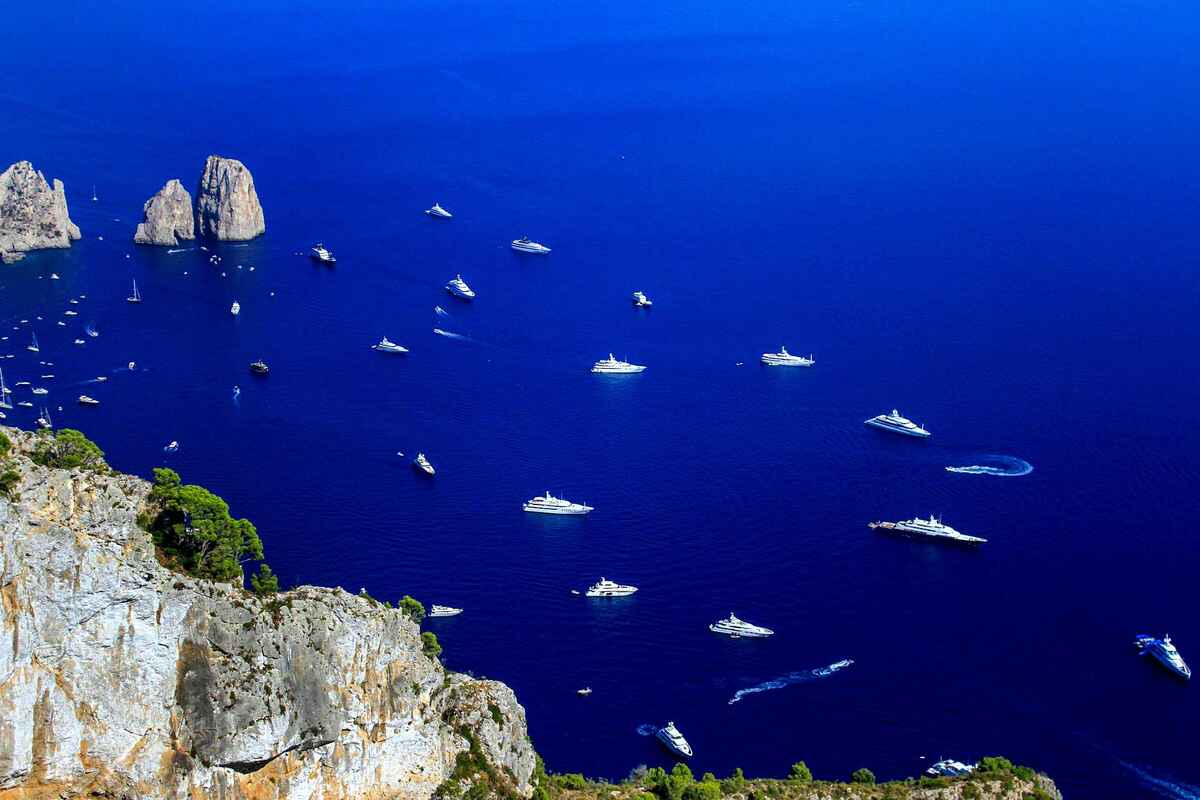
Why Are the Faraglioni the Symbol of Capri?
The Faraglioni, three colossal limestone sea stacks jutting from the depths off the southeast coast, are the unequivocal geographical icon of Capri, functioning as a logo for everything from vintage travel posters to local limoncello labels.
These formations are the result of millions of years of differential erosion, where the relentless force of the Tyrrhenian Sea carved away the softer rock, leaving only the dense Triassic dolomite skeletons behind.
Their scientific names—Stella, di Mezzo, and di Fuori—are less romantic than their implied mythology, as Homer’s Odyssey infamously describes the “wandering rocks” or Planctae, which some scholars suggest were inspired by the treacherous geology of this coastline.
The Faraglione di Mezzo is the most famous, pierced by a natural 60-meter-long arch large enough for a small boat to navigate through.
The local tradition of passing through this rocky arch is a sentimental ritual that ship captains perform with a theatrical precision honed over generations. In the midday sun, the water beneath the arch turns a deep teal, and the sudden shift from open sea to the enclosed, echoing tunnel creates a brief moment of profound disequilibrium.
According to local maritime lore, couples who exchange a kiss while their boat passes precisely under the arch are granted eternal love, a tradition that keeps the waters around the rocks constantly flecked with white wakes from circling tour boats.
However, the secret to fully appreciating these giants is to view them not just from the sea but from the gardens of Augustus, where the planted terraces of helichrysum and agave frame the rocks against a boundless marine horizon.
The Faraglione di Fuori, detached furthest east, is scientifically notable as a habitat for the unique Podarcis sicula coerulea, a stunning species of blue lizard endemic to this single rock.
Its coloration, a brilliant azure matching the surrounding sea, is a textbook case of insular evolutionary adaptation, a biological marvel that has captivated herpetologists and nature-focused visitors alike.
Access to stack itself is strictly prohibited to protect this fragile micro-ecosystem, a necessary regulation that underscores Capri’s delicate balance between mass tourism and environmental conservation. The presence of this rare creature elevates the Faraglioni from a simple scenic photo op to a living natural history site.
Understanding why these stacks symbolize Capri requires acknowledging their role in the island’s visual and psychological narrative of arrival. For centuries, sailing ships approaching from Naples would identify Capri first by these distinctive fangs of rock, signaling the gateway to safe anchorage at Marina Piccola.
The juxtaposition of their stark, rugged geometry against the manicured gardens and luxury hotels of the mainland defines the island’s essence: wild nature tamed by human artistry.
Capturing them in the golden hour, when the sun backlights the rock and the sea mist diffuses the light into a soft halo, is the definitive Capri photographic experience that no travel guide can fully prepare you for.
Navigating the Piazzetta: The Beating Heart of Capri Town
Officially named Piazza Umberto I, the Piazzetta of Capri is less a public square and more a compressed theatrical stage where the global elite, day-trippers, and stoic locals perform a carefully balanced social dance.
This tiny paved area, framed by the baroque clock tower of Santo Stefano and a ring of outdoor cafés, operates as the island’s definitive living room, where the entire emotional spectrum of a Capri day plays out.
To call it small is a geographic understatement; at just a few dozen meters across, its centrality is entirely psychological, a funnel through which every arrival and departure of the funicular railway must pass.
Sitting at Gran Caffè Vuotto or Bar Tiberio for an espresso is not a cheap caffeine break but an entry ticket to one of Italy’s most famous theaters of public life.
The history of this social epicenter is layered; it began as a simple market space adjacent to the bishop’s palace, evolving into the terminating point of the funicular line that opened in 1907.
This engineering feat connected Marina Grande to the town center, instantly transforming the Piazzetta into a democratic yet glamorous arrival parlor where fishermen and film stars collided.
The four whitewashed buildings enclosing the space, with their deceptive simplicity and trompe l’oeil architectural details, serve as a physical boundary to a world that feels both intimately small and impossibly grand.
Observing the precise ritual of the evening passeggiata, where the entire town circulates, stops, and greets, is a masterclass in Italian social structure that no museum could replicate.
From a practical perspective, the Piazzetta is the central node from which all Capri’s exclusive shopping lanes, including Via Vittorio Emanuele and Via Camerelle, bifurcate like capillaries.
Every bus stop, taxi stand, and the funicular entrance radiates from this single point, making it impossible to avoid passing through multiple times a day.
This forced centrality makes it an excellent base for people-watching but a poor location for a quiet, budget-friendly meal; the markups on even a simple Aperol Spritz can be stratospheric.
Walking just 50 meters down Via Le Botteghe immediately halves the price and doubles the local character, a crucial geographical hack for the cost-conscious traveler.
However, dismissing the Piazzetta as a tourist trap misses its authentic function as the island’s information exchange and clock. The bells of the 17th-century campanile mark the tempo of the day, ringing out over conversations that zoom from high-finance mergers to the latest local orange harvest.
For a moment of profound quiet, step into the shadowy interior of the Santo Stefano church to see the historical maps and the prized silver statue of Saint Costanzo, the island’s patron.
Exiting back into the blinding white light of the square, you realize the Piazzetta is not a place to see but a place to feel the island’s pulse, a true rite of passage for anyone writing a travel guide to Capri, Italy, including its history.
What Are the Best Hiking Trails for Coastal Splendor?
Capri’s most profound theater of natural beauty unfolds not on a motorized boat or in a boutique, but on the ancient mule paths and rugged coastal trails that trace the perimeter of this limestone massif.
The sheer scale of the geological drama, with cliffs plunging 300 meters vertically into turquoise abysses, is only fully accessible to those willing to lace up rigid-soled walking shoes and abandon the road.
The network of paths, painstakingly maintained by the island’s historical association, offers a sensory immersion into the Mediterranean maquis that buses simply cannot provide; the scent of wild rosemary, pine resin, and hot juniper berries becomes your constant companion.
Trekking here connects you directly to the logistically isolated Capri of the 18th century, when these very paths were the sole ground-based arteries for commerce and survival.
The undeniable classic is the Sentiero dei Fortini, an unfurling thread on the western coast that strings together three blockhouses built by the British and French during the Napoleonic Wars.
A challenging yet deeply rewarding six-kilometer route largely devoid of crowds, it traverses the wild flank of the island overlooking the Punta Carena lighthouse.
The path dips and ascends through a surreal landscape of gnarled olive trees and dizzying drop-offs, where the azure of the water appears as a great, vibrating beast of color.
At Fortino di Mesola, one reaches a sublime architectural paradox: a heavy coastal military battery floating seemingly untethered above infinite space. The historic defensive walls now serve as a perfect observation point for identifying seabirds and catching an unfiltered sunset unmediated by cocktail bars.
For a shorter, more domestic yet equally spectacular trek, the sentiero connecting the Grotta di Matermania to the Arco Naturale is unmatched in geological fantasy.
This path winds through dense holm oak forest before depositing you at a towering Paleolithic limestone arch, a stark skeletal bridge framing the sea and sky. The arch is a remnant of a collapsed marine grotto, its massive span a testament to the material’s stubborn resistance to gravity.
Standing under this natural architecture, you hear the crash of waves echoing up from a hidden cove below, a sound that has reverberated through the island for millennia, completely unchanged by tourism.
A small side trail leads to the Grotta di Matermania itself, a cave converted into a nymphaeum by the Romans, adorned with fragmentary opus signinum floors.
One should not underestimate the classic, albeit more trafficked, descent from Villa Jovis back to the town via the Astarita path. While the villa itself pulses with historical energy, the walk back reveals the sheer strategic genius of Tiberius’s engineers.
The panoramic perspective shifts every hundred meters, offering an acute sense of the island’s verticality and the isolation of the emperor’s perch.
It is essential to carry a minimum of two liters of water per person on any trail, as the limestone acts as a thermal battery, radiating intense heat on summer afternoons.
Early morning or late afternoon treks between April and October are mandatory safety considerations due to the scorching midday radiation, proving that the best way to understand the coast is to conquer it on foot.
Underground Capri: Unearthing Roman Imperial Ruins
While the visible drama of Villa Jovis dominates most itineraries, the true operational complexity of Roman Capri lies buried under the modern town and wild scrubland, an extensive network of subterranean engineering and elite housing.
The Palazzo a Mare, a vast maritime villa complex near Marina Grande, was Emperor Augustus’s original acquisition, a sprawling structure built down to the water’s edge where he sought a retreat from the political heat of Rome.
Unlike Tiberius’s later aerial paranoia, Augustus’s villa was a statement of accessible majesty, with a port directly connected to the palace for the smooth arrival of diplomatic fleets. Presently, the partially excavated ruins are often overlooked, yet they convey a distinct sense of the luxurious maritime life that prefigured the later imperial excesses.
Just steps from the bustling Piazzetta lies the recently renovated Giardini dell’Augusteo, a panoramic terrace that sells itself as a view, yet serves as the roof for the finely preserved Oratorio di Santa Maria.
But the real prize beneath the town rests in the Villa della Despoliata, a site of ongoing archaeological recovery revealing fine marble opus sectile floors and panoramic maritime windows that speak to a high-status residential area.
Descending deeper, one discovers the intricate Roman aqueduct systems that delivered fresh water across impossible topographies, channels carved by hand through solid dolomite to feed the baths and fountains of the elites.
These caverns, often cool and damp, demonstrate the technological ambition that allowed a dry limestone rock to become a self-sufficient imperial capital.
Villa Damecuta, an atmospheric ruin stretched along Anacapri’s northern cliff, is associated not only with Tiberius but later with a medieval tower built directly into the Roman foundations.
As you walk through its shattered brick corridors, you can see how the walls dissolve into space, with the island of Ischia smoking in the distance. There is a poignant emptiness here, as the opus reticulatum masonry stands open to the sky, colonized by caper plants that bloom defiantly pink in the cracks.
Local legend insists this was the site of Tiberius’s most private excesses, far from the formal administrative center at Jovis, a believable claim given the remote, melancholic poetry of the site.
To fully appreciate these underexplored layers, consider hiring a local archaeological guide certified by the Campania region, a decision that will transform scattered stones into a coherent social narrative.
The Parco Archeologico di Capri organization is constantly surveying with advanced LiDAR technology, which now suggests substantial villa complexes remain undiscovered beneath the vineyards of the interior.
Visiting the Certosa di San Giacomo, the 14th-century Carthusian monastery that now houses a museum with recovered statuary, provides the final piece of this archaeological puzzle.
The marble torsos and reconstructed fresco fragments offer a tangible glimpse into the interior aesthetics that defined these clifftop retreats, completing the historical picture that a casual stroll cannot achieve on its own.
A Culinary Journey Through Authentic Caprese Cuisine
The cuisine of Capri is a distinct terroir-based experience deeply rooted in the limestone soil and maritime microclimate, a culinary dialect that speaks of extreme simplicity executed with ritualistic precision.
To eat here is to taste the Mediterranean sea spray and volcanic earth simultaneously, a fusion of the Neapolitan mainland’s substance with an islander’s minimalism.
The global icon born here is the Insalata Caprese, a plate that traces its creation to a patriotic post-World War I chef who wanted to represent the Italian flag: red tomato, white mozzarella, and green basil.
Consuming this dish on the island, where the milky di bufala or fior di latte cheese is often produced in the hills of Anacapri and the tomatoes are sun-burst with flavor, redefines the cliché entirely, stripping away the heavy balsamic gloops too common abroad.
Equally sacred is the Raviolo Caprese, a large single pasta pillow served in a light cherry tomato and butter sauce that holds a secret within its floury walls.
Unlike generic ricotta fillings, the traditional caprese raviolo contains caciotta, a soft local cow’s milk cheese that melts into a gooey core during its brief three-minute boil, alongside aromatic fresh marjoram picked from the mountain.
The semolina pasta is rolled thick, providing a substantial chew that contrasts beautifully with the delicate acidity of the Tommasone tomato liquid, never reduced to a heavy sauce.
The most transcendent versions are found not in the visible main-street establishments but in the backstreets of Anacapri, where nonnas make the pasta in the morning stillness.
Seafood here adheres to the philosophy of minimal manipulation, honoring the intense clarity of the Tyrrhenian catch, such as pezzogna and spigola.
The totani e patate, a lowly-looking stew of squid and potatoes slow-cooked in a terracotta pot with white wine and local Gaeta olives, is a masterclass in texture, the cephalopod meltingly soft rather than rubbery.
The best places to eat this are not the high-end panoramic terraces but the beach clubs at Marina Piccola, where the sunset view comes for free with a plate of spaghetti alle vongole veraci.
The tiny, sweet local clams, caught that morning in the Bay of Naples, open in a garlicky oil that demands the ritual scarpetta bread swipe, a gesture that is the highest possible compliment to a campanian cook.
The island’s symbolic liqueur, limoncello, is a shard of concentrated sunlight, made from the thick-skinned, intensely aromatic sfusato amalfitano or femminello lemon grown in terraced gardens.
The exclusive orange orchards of Anacapri yield the rarer aurum, a golden liqueur made from local scarlet-skinned orange peels and aged grappa, far more nuanced than its yellow cousin.
For a truly localized dessert, the Torta Caprese stands as a historical anomaly, a flourless chocolate and almond cake invented accidentally in the 1920s by a baker who forgot to add the flour.
The result is a dense, fudge-like confection that dusts the palate with dark cocoa and the distinct nutty texture of the locally grown almonds, a perfect end to a meal defined by blessed accidents and sun-baked intensity.
Capri by Sea: Chartering a Boat Around the Island
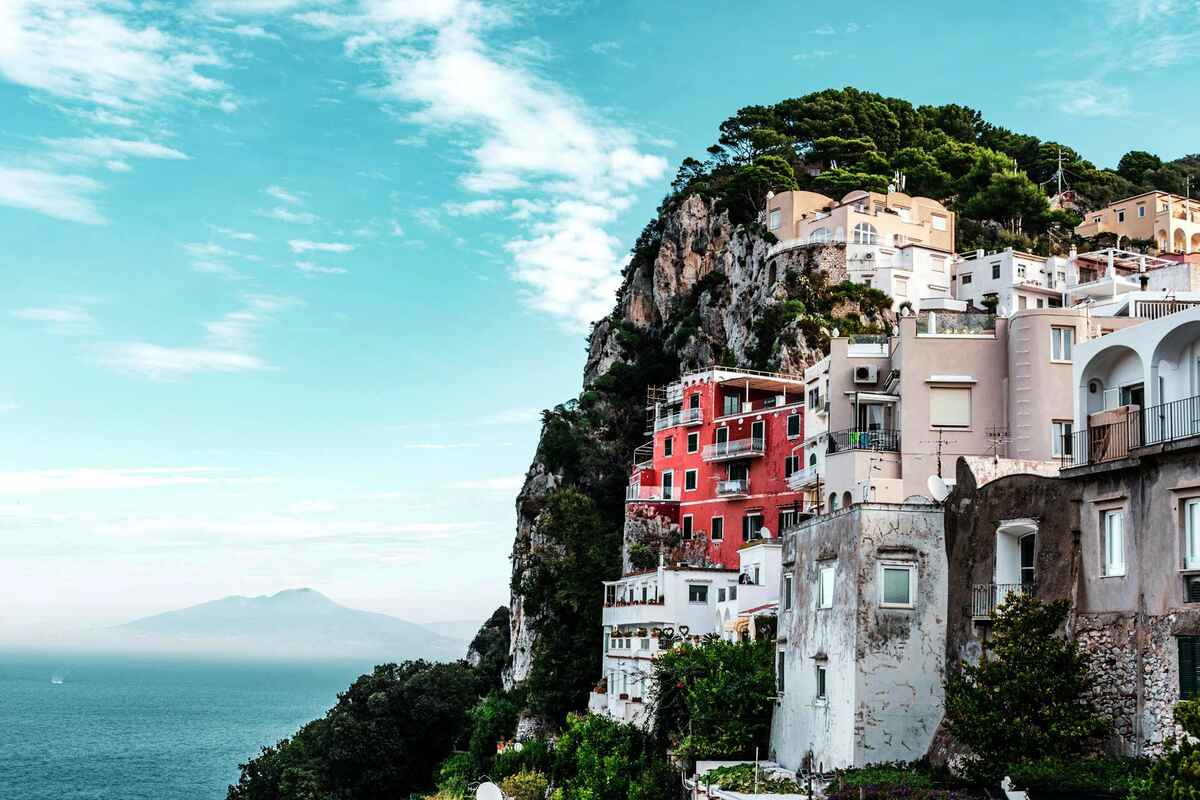
A circumnavigation of Capri by sea is not a mere activity but a mandatory geographic ritual, the only way to read the narrative of the island as a three-dimensional sculpture carved by the elements.
The 17-kilometer perimeter is a continuously shifting gallery of rock arches, talc-white cliffs stained with green moss, and shimmering coves that no land-based viewpoint can unveil.
The iconic tour departs from Marina Grande, immediately swinging around the western promontory toward the Bagni di Tiberio, where submerged Roman masonry still honeycombs the seabed in a crystal syrupy blue.
From this vantage, the physical remoteness of Villa Jovis appears terrifyingly absolute, its walls growing directly from the vertical fang of rock as a crystallization of paranoia and absolute aesthetic command.
The finest way to experience this hydro-geological spectacle is via a traditional gozzo sorrentino, a broad-beamed wooden vessel painted in distinctive turquoise and white, helmed by a skipper who knows the precise timing of shifting shadows.
A gozzo seats up to six passengers intimately under a canvas sunshade, allowing you to slip under grotto arches and through the Faraglioni ring where larger tourist ferries cannot navigate.
The route past the Punta Carena lighthouse is a transition into the wildly rugged archaeology of the west, where the Grotta Verde and Grotta Bianca display the alchemy of light on water.
Snorkeling gear is standard equipment; plunging into the water off the boat in the so-called “Cave of the Saints,” a cathedral-like cavern with a hidden pebble beach, provides a deep thermal contrast as cold freshwater springs mix with the warm ocean saline.
For a more active maritime experience, a guided sea kayaking excursion provides a silent, low-slung perspective that makes the Faraglioni seem unbearably monumental.
Paddling your own craft gives you a sense of agency and connection to the marine environment, gliding through water so transparent that the shadows of fish race across the sandy floor far below.
The physical effort of rounding the wind-battered southeastern tip brings the strategic isolation of the Roman complexes into sharp, physical focus, showing exactly how the geography defended the emperors.
Kayaking also facilitates discreet access to the shallows near the Arco Naturale, where a waterfall of limestone debris creates a surreal underwater architecture.
When negotiating a charter, it is critical to confirm the itinerary around the entire island, including the Blue Grotto’s exterior, as some economical tours merely cut across the bay without completing the full loop.
Private sunset tours offer the singularly beautiful phenomenon of the “golden hour” hitting the calcium carbonate cliffs, lighting the island on fire for a deeply cinematic twenty minutes.
Be rigorously prepared for the intense marine sun, which doubles its reflective intensity on the water; high-SPF mineral sunscreen, a large hat with a chin strap, and a significant volume of chilled water are non-negotiable safety requirements.
The sea state can change rapidly around the exposed western tip, so confirming the weather window and trusting the skipper’s judgment regarding swell—particularly the fast-rising sirocco wind—is essential for a safe and euphoric experience on Capri’s waters.
Where to Find the Most Breathtaking Viewpoints?
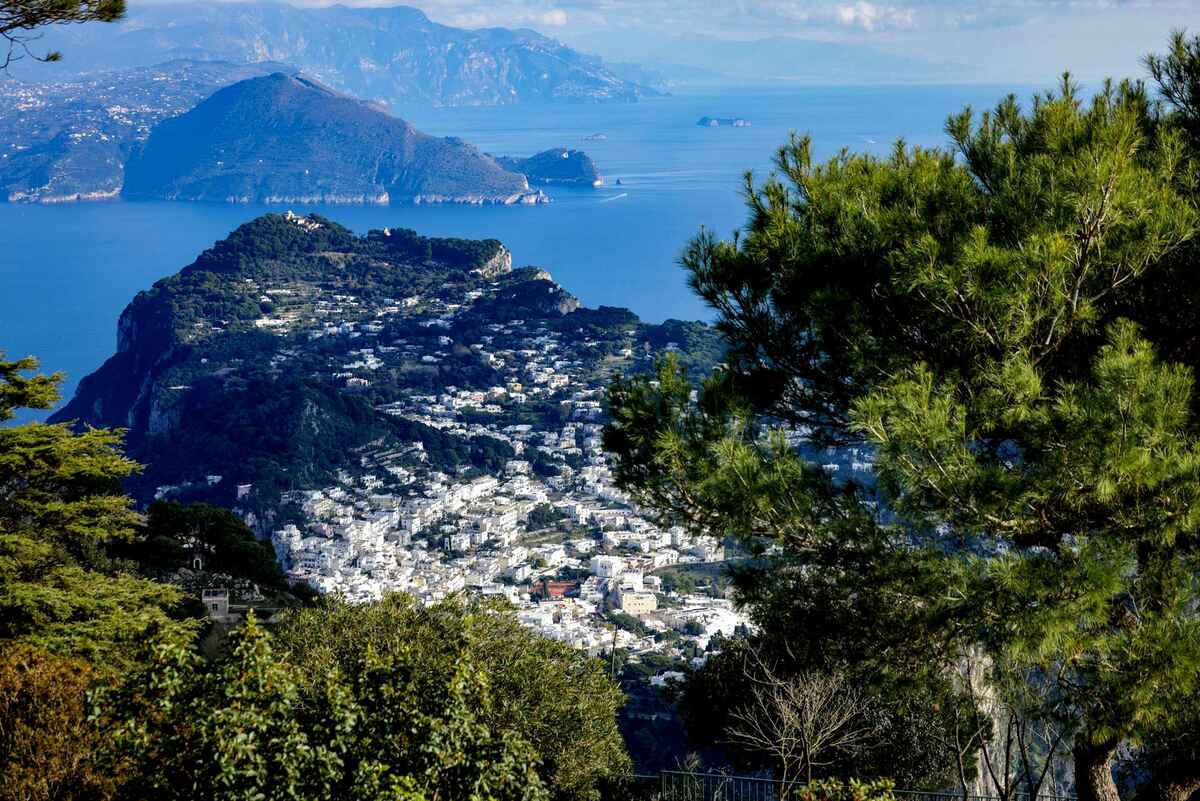
The geography of Capri is a master class in dramatic elevation, its topography designed by tectonic violence to offer a series of natural infinity decks that reorient our sense of scale relative to the sea.
The most iconic of these, the Belvedere of the Gardens of Augustus, is a lush botanical promenade that cantilevers over the sheer cliff above the switchback Via Krupp.
The view faced directly at the Faraglioni stacks has a compositional perfection, manically tended beds of magenta bougainvillea and sculpted juniper leading the eye up to the soaring rock formations and down across the white specks of Marina Piccola far below.
The paradoxical calm of this structured natural frame, created by a Swedish anarchist doctor and a German industrialist designer, stands in stark contrast to the ungovernable maritime wilderness it frames.
For a perspective that swaps manicured gardens for raw alpine exposure, the summit of Monte Solaro via the chairlift is unbeatable, a 360-degree panopticon of the entire Gulf of Naples.
Up here, beyond the reach of the aromatic flowering shrubs, the geology is naked and sharp, a karstic wasteland that feels more akin to a remote Greek island than to the glamorous Campania below.
Standing at the very edge of the precipice, where the statue of Emperor Augustus stares unblinkingly at the distant Vesuvius, one grasps the unifying principle of the entire island: the tyranny of the vertical.
The wind on the summit is a constant cleansing force, and the cloud shadows glide across the blue skin of the sea in a panorama that reveals the geological scars of the Campi Flegrei volcanic field.
Descending into the town, the viewpoint at Punta Cannone is a well-guarded local secret, reached via a short pine-shaded detour that filters out 90% of the day-tripper crowd.
This rocky outcrop, formerly a semaphore station, sits at the exact right-angle point between the south and east coasts, offering a simultaneous view of the Faraglioni on one side and the Sorrentine Peninsula on the other.
There are no railings, only a carpet of dry pine needles and a derelict wall, creating a sense of precarious, secret ownership of the entire bay. The perspective from here includes the intricate terracing of the ancient vineyards, a man-made lattice of dry stone walls that has held the mountain together for centuries.
The Terrazzo dei Grandi, buried deep within the pathway connecting the Certosa di San Giacomo to the Gardens, reveals a quieter, more introspective view of the port.
The belvedere frames the intense complexity of the marine traffic below, the hydrofoils tracing white parabolas on the deep indigo as they vector in from Naples, providing a kinetic counterpoint to the static architecture of the cliff.
The best time to visit any of these vantage points is universally late afternoon, when the transiting sun saturates the water with a fluid gold light and the harsh shadows of midday soften to reveal the intricate textural details of the limestone.
All these lookout points, while safe enough for standard visitation, demand careful attention to loose gravel and a respectful distance from eroding cliff edges, a natural risk inherent in the island’s breathtaking geometry.
The Artisan Shops and Boutiques You Should Not Miss
The retail landscape of Capri is a tale of two economic extremes: the high-octane glitz of luxury maisons lining Via Camerelle, and the deeply authentic, multi-generational artisan workshops hidden in the narrow back laneways of the old town.
The commercial soul of the island has always been tied to craftsmanship, born from a historical necessity to create textiles and shoes when maritime trade was scarce.
Today, the most exclusive shopping experiences are not found in the globalized storefronts of Bottega Veneta or Brunello Cucinelli, but in the small laboratori where the scent of newly tanned leather and the rhythmic tapping of a cobbler’s hammer replace the sterile silence of high-street retail.
These artisans genuinely shape the material identity of an island whose product culture is as iconic as its views.
The legendary Canfora sandal workshop, a tiny, immaculate space near the Grand Hotel Quisisana, represents the apex of this tradition.
Opened in 1946, the shop originally made sturdy footwear from recycled tires for the local vine-tenders, only to evolve into the handcrafted paradise worn by Jacqueline Kennedy and subsequent generations of aristocratic beauties.
Here, every sandal strap is hammered flat by hand, and the intricate faux-jewelry designs are entirely bespoke, created and adjusted on your foot in a single sitting by master craftsmen in white lab coats.
The quality of the locally tanned leather is exceptional, resistant to the punishing saline environment and designed to be re-soled and revived indefinitely, a direct rejection of fast-fashion disposability.
Perfume is another long-standing island art form, with the Carthusia laboratory tracing its origin myth back to a 14th-century Carthusian prior who distilled wild cliffside carnations as a welcome gift for the visiting queen.
The workshop maintains a strict small-batch production that relies heavily on the endemic raw ingredients of Monte Solaro, including wild rosemary, Caprian lavender, and the intensely fragrant, rare giglio di San Costanzo wild lily.
The flagship store, discreetly nestled a short walk from the Piazzetta, offers the distinct scent “Aria di Capri,” an olfactory snapshot of the island’s morning mimosas, tobacco leaves, and sun-warmed fig wood.
Bringing home a bottle is like bottling the exact atmospheric pressure of a Capri spring morning, a souvenir with deeper sensory memory than any photograph.
For table linens and fine embroidery, the women of Anacapri have woven a textile tradition that rivals the French ateliers, utilizing intricate punto antico needlework and drawn-thread techniques passed down in matrilineal lineages.
The boutiques along Via Giuseppe Orlandi display heavy, hand-finished panels of sea-blue and sun-yellow linen, perfect for a formal dining setting, along with delicate organic cotton christening gowns.
These pieces are not cheap, but observing the artisan, often an elderly woman with fingers swift from sixty years of practice, demonstrates where the value lies.
Complement this with a visit to the tiny ceramic bottegas near the church, where tiles depicting the Faraglioni are hand-glazed in the vibrant, zinc-rich yellows and ultramarine shades defined as distinctly capresi, ensuring your suitcase holds the tangible weight of a local hand.
Planning Your Day Trip or Extended Stay on Capri
The logistical rhythm of Capri operates on a tidal clock dictated by the arriving and departing hydrofoils, and deciding between the frantic, snapshot day trip or the deeply immersive overnight stay fundamentally alters the nature of your visit.
The day-tripper, arriving typically around 10:30 a.m., experiences the island at its most congested zenith, caught in a Darwinian rush for bus tickets and Blue Grotto slots alongside thousands of others.
This is a valid, albeit compressed, survey of the marquee checkpoints, allowing you to hit the Piazzetta, take a quick chairlift up Monte Solaro, and snap the necessary photographic evidence before the 5:00 p.m. exodus.
To maximize this compressed schedule, pre-booking your funicular and ferry tickets and eating a standing snack rather than a seated lunch is a tactical necessity that saves crucial queuing hours.
However, the real character of Capri emerges only after the last large ferry departs, releasing a profound, almost audible sigh of calmness that descends upon the cobbled streets.
By staying overnight, you unlock the “whisper hour” at sunset and the “golden hour” at dawn, when the gardens are empty, the lizards reclaim the sun-warmed walls, and the Faraglioni are etched against a pink-violet sky rather than a bleached white glare.
Accommodation varies wildly, from converted medieval monasteries like the exclusive Casa Morgano to more modest yet authentic family-run affittacamere in Anacapri that provide panoramic terraces for a fraction of the central price.
Sleeping on the island transforms your identity from a transactional tourist to a temporary resident with the right to linger over a local digestif without watching the clock.
Transport logistics within an extended stay warrant careful planning, given the tiny, packed orange buses that brave the dangerously narrow switchbacks connecting the two towns.
The standard and simplest method is the UnicoCapri integrated ticket system, allowing day-long access to buses and, crucially, granting a single return ride on the funicular to Marina Grande.
For those staying longer, renting a micro electric cart or scooter, while requiring a valid international driver’s permit, offers the liberty to explore the Belvedere di Migliera or the remote Punta Carena lighthouse on your own schedule.
It is vital to respect that private car ownership is strictly forbidden for non-residents from April to October, making advance transport planning non-negotiable.
Seasonality dictates the nature of a longer stay emphatically. July and August intensify the temperature, prices, and density of human traffic to an extreme that can fray even the most patient traveler’s nerves.
Conversely, the shoulder seasons of May, June, and late September transform the island into a slice of paradise, the wildflowers carpet the clifftops, the sea water is perfectly swimmable, and the tourist-to-local ratio shifts to a pleasanter balance.
For extended stays, utilizing the porters at the Piazza, recognizable by their official badges and wooden carts, is a worthy investment, as they will navigate the car-free vertical maze with your luggage to your hotel.
This small logistical concession saves both personal sweat and the cacophony of hard-shell wheels grinding over ancient paving stones, preserving the island’s sonic serenity.
Safety, Practical Tips, and Seasonal Considerations for Capri
Capri is by global standards an exceptionally safe island, yet its unique topography and high-end tourist volume present specific hazards and practical irritants that require forewarned preparation.
Petty crime takes the form of opportunistic pickpocketing on the extremely crowded bus #1 connecting the port to Anacapri, where the press of bodies creates a blind spot for zippers and pockets.
A money belt or a zipped crossbody bag kept physically in your lap serves as a far better deterrent than a back pocket, particularly during the chaotic 4:00 p.m. rush back to the marina.
There are no dangerous nocturnal slums in the traditional sense, but the maintenance of public lighting on remote mountain paths like the trail to the Arc Naturale is sporadic, so a small flashlight is essential if you plan to watch the sunset away from the central Piazzetta.
The sheer verticality and the limestone geology define the most acute physical risks, with hiking paths often consisting of unrailed precipices and heavily worn, polished stone steps that become lethally slick after a brief summer thundershower.
Standard flip-flops are catastrophically ill-suited for any exploration beyond the Piazzetta, with sturdy, treaded footwear mandatory for visiting Villa Jovis or descending the Phoenician Steps to the sea.
The local sea conditions, usually placidly turquoise, can shift abruptly as a land breeze funnels down the ravines, transforming the swimming areas around the Faraglioni into choppy, dangerous currents for moderate swimmers.
Always heed the red wind warning flags and the advice of local boatmen, as they hold an empirical knowledge of the Tyrrhenian’s moods that a weather app cannot replicate.
Medical facilities on the island are limited to the Capilupi Hospital located in Anacapri, which handles minor trauma and emergencies effectively but necessarily stabilizes and transfers serious multi-trauma cases to the larger Cardarelli hospital in Naples.
The island’s lone pharmacy, a crucial resource for European EHIC or GHIC card holders, is often closed for the traditional afternoon siesta, so a personal compact medical kit with anti-inflammatories, strong antihistamines for insect bites, and blister plasters is a prudent inclusion.
The summer sun reflecting off the white architecture and sea surface creates an exponential UV exposure index, making a high-factor SPF 50 sunscreen, polarized sunglasses to filter the intense glare, and a wide-brimmed hat mandatory protective equipment.
Dehydration and heat exhaustion are the most common ailments that derail a Capri itinerary, directly combatted by the habitual purchase of multiple large bottles of acqua minerale from alimentari shops rather than sipping dehydrating espresso exclusively.
Seasonal rhythms dictate almost every aspect of the travel experience, with winter seeing a profound shutdown of beach clubs, ferries, and restaurant activity despite the island’s permanent residential population.
While a day trip in April reveals a blossoming, green island, the Tyrrhenian water temperature remains brisk at 16-17 degrees Celsius, unsuitable for extended swimming without a neoprene layer.
The busiest periods around Ferragosto in mid-August and the international weekends of the Regata dei Tre Golfi see a surge in anchoring superyachts that choke the waters and fully book all private transport.
Checking current schedules for the Caremar and SNAV hydrofoils is critical not just for departure but for arrival, as winter storms or scirocco winds often cancel all crossings, potentially trapping day-trippers on the mainland or, more pleasantly, unexpectedly overnight.
Conclusion
Capri is much more than its reputation as a glossy playground for the international jet set; it is a geological marvel, an archaeological palimpsest, and a cultural theater where history and hedonism perform a perfectly balanced duet.
As this travel guide to Capri, Italy, including its history, demonstrates, the island rewards the curious traveler who ventures beyond the crowded hour of the Piazzetta into the silent ruins of the imperial villas, the windswept hiking trails, and the humble artisan workshops of Anacapri.
The enduring splendor of this limestone rock lies in its ability to simultaneously humble and intoxicate, drawing a line directly from the paranoid gaze of Tiberius to the ecstatic selfie of a modern tourist.
Every view of the Faraglioni and every taste of the local ravioli is a small induction into a very specific and deeply luxurious sense of place that cannot be replicated elsewhere in the world.
To experience Capri properly is to surrender to its specific tempo: the patience required to wait for the swell to enter the Blue Grotto, the stamina to climb the panoramic steps, and the leisure to sit for hours with a limoncello as the sunset melts into the sea.
The island refuses to be rushed, and any attempt to conquer it in a two-hour sprint results only in a transactional encounter with its most superficial layer, governed by queues and overheated frustration.
In its quieter moments, however, Capri reveals its authentic heartbeat, the rhythmic whisper of the Tyrrhenian against the limestone stacks and the scent of wild jasmine hanging in the still night air. The memory one carries away from this calculated slowness is not just a photograph but a refined sensory imprint.
As you plan your itinerary, remember that conditions on this living, breathing rock are dynamic, and the infrastructure that supports tourism is inherently subject to the whims of the sea and the season.
Travel conditions, entry prices, hydrofoil timetables, and even the accessibility of remote archaeological sites can shift overnight due to weather or conservation work, so checking live local information sources is highly recommended before a long journey.
The reward for this careful preparation is a glimpse behind the veil of a destination that history and nature have protected fiercely, a place where the grandeur of the Roman Empire feels as immediate as the taste of a sun-warmed San Marzano tomato.
Carry a water bottle, trust your instincts, and let the limestone labyrinth of Capri reveal its most precious secrets to you in its own elegant time.
FAQ
What is the best time of year to visit Capri?
The optimal windows are the late spring, from May to mid-June, and the early autumn, particularly late September through October. During these shoulder seasons, the wildflowers are in peak bloom, the swimming water is comfortably warm, and the intense congestion of the August holiday exodus becomes manageable. Hotel rates drop from their July peaks, and the open-air hiking trails are not oppressively scorching.
Is it necessary to book the Blue Grotto in advance?
Official advance booking for the rowing boats into the Blue Grotto does not exist as a single integrated system; access is managed by a local cooperative of boatmen, and entry is strictly on a first-come, wait-in-line basis. You can pre-book private boat tours that include the grotto’s exterior, but to enter, you must still transfer to the official wooden skiffs, paying the separate entry and boatman fees directly at the floating ticket office.
Can you visit Capri on a budget?
While Capri is inherently a premium destination, budget travel can be achieved by staying overnight in a basic Anacapri B&B rather than a coastal hotel, using the public bus network instead of private convertible taxis, and eating away from the Piazzetta. Purchasing fresh panini, tomatoes, and mozzarella from the local alimentari for a scenic picnic offers a gourmet meal at a fraction of the cost of a waterfront restaurant.
How many days do you actually need in Capri?
Two to three full nights provide the temporal sweet spot to transcend the superficial day-trip rush. This duration allows for a full coastal trek, a relaxed morning at Villa San Michele, a dedicated sunset boat tour around the Faraglioni, and an evening experiencing the transformative quiet after the last ferry departs.
Is Capri safe for solo travelers?
Capri is widely considered extremely safe for solo travelers, with negligible violent crime and a well-patrolled, tourist-centric core. The primary risks involve falls on unrailed hiking trails or slipping on polished limestone steps, making attentive navigation and sturdy footwear far more critical than personal security concerns.
What is the best way to get around Capri without a car?
The public orange minibuses and the funicular connecting Marina Grande to the Piazzetta form an efficient bone structure for the island. To cover the coastline, highly maneuverable gozzo sorrentino private boats offer a sublime form of transport that bypasses the narrow cliff roads completely, while taxis, which are convertible white cabs, service areas buses cannot easily reach.
Are the beaches in Capri sandy or pebbly?
The coastline of Capri is predominantly dramatic rock platforms and polished pebble coves, lacking the long sandy stretches found on the mainland. The most popular swimming spots, like Marina Piccola and the Bagni di Tiberio, are equipped with lidos that place sunbeds directly onto stone terraces or platforms, with easy ladder access directly into the crystalline deep water.
What is the main dish you must try in Capri?
Beyond the ubiquitous Insalata Caprese, the must-try dish is the authentic Ravioli Capresi, coated in a fresh cherry tomato sauce and filled with a soft caciotta cheese and marjoram. This dish is a stark departure from the standard balsamic-drenched commercial versions found elsewhere and properly represents the simple, high-fat mountain content of the local dairy produce.
Do you need to speak Italian to visit Capri?
In the main commercial zones, the luxury boutiques, and the high-end restaurants, fluent English is spoken universally and often confidently. For a more seamless experience in the artisan workshops of Anacapri or the remote hiking refreshment stops, knowing a few standardized polite Italian phrases regarding greetings, prices, and directions serves as a classic bridge of courtesy.
How reliable is the ferry service to Capri?
The modern high-speed hydrofoils and traditional ferries are reliably punctual during the calm, high-summer months of peak traffic. However, these maritime connections are fundamentally weather-dependent, and during winter months or sudden sirocco wind events in the transitional seasons, all services can be abruptly suspended until sea conditions fall below the safety threshold, occasionally requiring flexible travel planning.

Author: Horeca Health
Horeca Health




Leave a Reply